


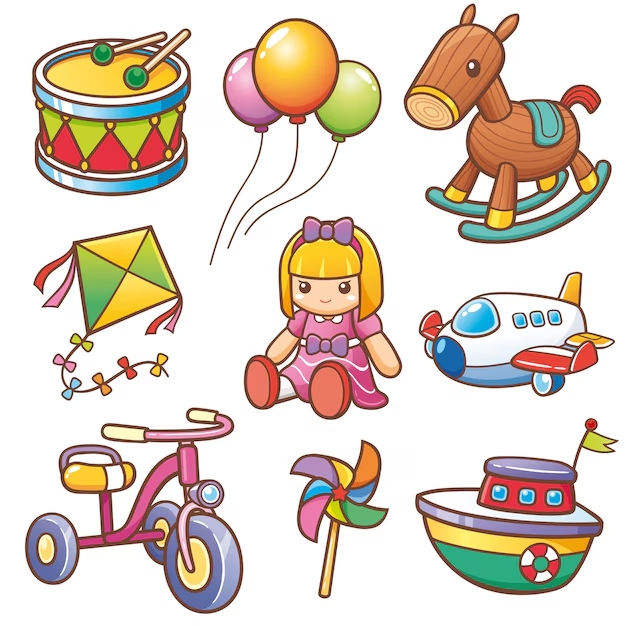
Learning and Educational Toys: Play That Teaches Without Lectures
If you watch children at play long enough, you see where learning lives: in a repeated attempt, a delighted “Oh!” when something clicks, and the quiet pride of getting it right. Learning and educational toys are the tools that invite those moments. They don’t look like school. They look like invitations — a stack of blocks that begs to be balanced, a simple puzzle that asks to be solved, a small kit that says “try this” and hands you everything you need to try.
The best educational toys make concepts concrete (numbers you can touch, patterns you can move), reward curiosity (a predictable reaction when you try something), and leave space for imagination. They teach by doing, not by lecturing.
What Makes a Toy Truly Educational (and Enjoyable)
A toy that actually teaches shares a few plain, human qualities:
- Clear cause & effect. The child performs an action and sees the result right away. That immediate feedback is the engine of learning.
- Repeatable challenge. Doing the same thing again and again should show small improvement, not boredom.
- Tactile satisfaction. Little hands need texture, weight, and resistance. A satisfying click or smooth slide helps the child learn what worked.
- Open-ended use. Toys with more than one “right” way stay interesting longer.
- Social potential. Toys that work alone and better with others teach language, sharing, and rules.
When a toy hits those marks, learning happens silently while the child is busy having fun.
Categories That Work (and Why)
Here are the practical toy categories that actually deliver learning — explained like someone who’s seen them in real playrooms.
1. Building & Construction
Blocks, magnetic tiles, and simple snap systems teach spatial reasoning and planning. Every tower that falls and gets rebuilt is a small engineering lesson.
2. Puzzles & Logic Games
Jigsaws, sequence puzzles, and matching games sharpen visual discrimination and persistence. They teach that problems have steps and can be solved.
3. Early Math Tools
Counters, abacuses, and sorting trays turn numbers into objects you can move. Math becomes manipulable, not mysterious.
4. Language & Story Aids
Letter magnets, storytelling cards, and puppet kits make words into play. They’re how vocabulary and narrative skills grow without drills.
5. Sensory & Fine Motor Tools
Play dough, lacing beads, pegboards, and sensory bins build the hand strength and focus that later support writing and careful tasks.
6. STEM & Maker Kits
Simple circuit sets, gear kits, and beginner robotics teach sequencing, debugging, and cause-effect in hands-on ways.
7. Music & Rhythm
Instruments and rhythm toys build memory and listening skills—and they’re just joy-in-a-box. Repetition of beats supports language cadence and recall.
8. Cooperative Games
Short board games that require turn-taking teach rules, strategy, and social patience—valuable school-ready skills.
How to Choose One That Will Be Used (Human Advice)
- Match the child, not the label. Are they builders, drawers, movers, or storytellers? Choose toys that fit temperament.
- Check for “one good thing.” A learning toy usually does a core thing well—don’t be seduced by gadgets that claim to teach everything.
- Feel the materials. If you can touch it, make sure it’s pleasant and durable. Little hands notice texture.
- Think scaling. Toys that grow in complexity or combine with others last longer.
- Consider social use. If often played with friends or siblings, a toy will teach social skills too.
How Adults Help (Without Taking Over)
A few easy habits make learning toys far more effective:
- Model once, then step back. Show one move and then let the child explore.
- Ask open questions. “What do you think will happen if…?” invites planning.
- Praise effort over outcome. “You tried a new idea—nice!” builds persistence.
- Rotate toys. Keep a small set out and tuck others away—returning toys feel fresh.
- Link play to life. Count spoons while cooking, describe textures during bath time—everyday routines make learning real.
Practical Toy Picks That Get Played With
- A set of chunky wooden blocks or magnetic tiles (open-ended building).
- A 12–24 piece puzzle with clear images (problem-solving).
- Counting bears with cups for sorting (hands-on math).
- Letter tiles and a puppet set (early literacy & storytelling).
- A sensory bin with scoops and cups (exploration & fine motor).
- A beginner coding robot or sequencing blocks (logical thinking).
- A short cooperative board game (turn-taking and rules).
These picks are small investments in repeated practice—the thing that truly builds skills.
Where to Find Thoughtful Learning Toys
For a curated collection chosen for durability and real learning value, explore Sonpal Toys. For quick demos, activity ideas, and snapshots of real play, visit Our Instagram.
The Bottom Line — Learning Happens in Play
Learning and educational toys are most powerful when they make discovery feel ordinary: a child pokes, spins, stacks, listens, and then knows a bit more than they did. Choose toys that reward curiosity, fit the child’s hands and temperament, and invite repetition. Play that teaches is gentle, patient, and generous — and when adults support it with small prompts and space, those tiny moments add up into real understanding.
